Heat pump water heater
Energy efficient electric hot water heaters
Heat pump water heaters are one of the most promising energy saving options in water heating. Although electric powered, there significantly more energy efficient than conventional electric storage tanks. In most applications, electric heat pumps are more efficient than conventional gas water heaters as well. In appropriate applications, a heat pump hot water heater consumes less electricity than a conventional storage tank, and at an equivalent or comparable first hour rating. Heat Pump Water Heating vs. Conventional Electric Water Heating Heat pump water heating uses electricity to transfer heat from an existing source (the surrounding air) to the domestic water. Conventional electric water heating utilizes electric resistance to heat elements that are immersed within the storage tank, along with the stored domestic water. Heat pump technology is a viable energy saving alternative to electric resistance because redirecting existing heat to stored domestic water requires less energy than directly generating or creating heat within a water heating storage tank.
The past
Heat pumps have been used in space heating and space cooling systems in both residential and commercial applications for several decades. In fact this same heat redirecting technology is utilized in refrigerators and storage freezers.
More recently heat pumps have been incorporated in both domestic water heating systems as well as swimming pool water heaters. This heat capturing and moving technology, while similar in freezers and refrigerators, is designed to operate in reverse when utilized in water heating systems.
Heat pump hot water heaters were first introduced by electric utility companies as a means of reducing peak hour demand. With the high initial cost, poor consumer awareness, and a lack of production from large appliance manufacturers, these systems failed to gain popularity with consumers and professionals alike.
The present
While electric utility companies continue to aggressively promote this technology, a few large appliance manufacturers have introduced heat pump water heaters, with other large manufacturers developing and/or announcing plans to follow suit. Some of the new generation heat pump models have earned energy star ratings and energy factor ratings of 2.0 and 2.5, which is significantly higher than most of the gas and electric powered residential storage tanks currently available. Today these models (as well as other models) are eligible for federal and state water heater tax credits, local electric utility rebates, and most current models are featuring longer product warranties. A handful of reputable mid size companies (that are U.S based) design, develop, manufacture and market electric heat pump water heaters that are ideal for both residential and light commercial applications.
Heat Pump Water Heating; An Under Utilized Technology
Unfortunately, heat pump water heating systems are very much underutilized in both residential and light commercial applications throughout most of the United States. Heat pump water heating is underutilized for several reasons; - Many home owners and business owners remain unaware of the superior efficiency of these water heating systems.
- Many contractors are either unaware or unfamiliar with heat pump water heaters and often times it's a contractor who recommends a replacement system or a new system in the case of new constructions.
- Compared to other technologies, there's often a lack of availability. Only a handful of reputable manufacturers are active in the residential and light commercial heat pump water heater market. For decades the industry's main focus has been on large commercial applications.
- The majority of heat pump water heaters are unavailable at retailers and public whole sellers. Manufacturers often utilize electric utility providers, independent representatives and some contractor based whole sellers to promote these systems for residential and light commercial applications.
How heat pump water heaters work
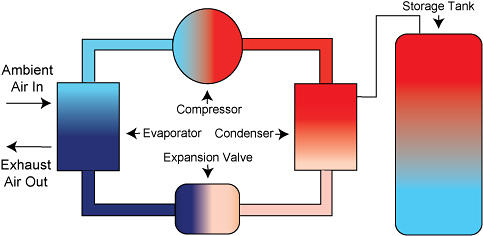
Air Source Vapor Compression Cycle These water heating systems use an air source heat pump. A vapor compression cycle gathers heat from the ambient (or surrounding) air and this gathered heat is then indirectly transferred to the stored domestic water. The major internal components within the heat pump vapor compression cycle are the compressor, the evaporator an the expansion valve. A refrigerant is circulated throughout the major components of the system. When the temperature of the stored domestic water falls below the temperature setting, the evaporator absorbs heat from the ambient air, with the assistance of an electric fan. The compressor is then activated, extracting refrigerant vapor from the evaporator coil. The systems' refrigerant vapor is then pressurized and heated by the compressor. The pressure applied by the compressor transforms the refrigerant into liquid. The heated liquid refrigerant then enters the condenser. In most instances, the water is plumbed from the storage tank and through the condenser coils. The condenser serves as a liquid to liquid heat exchanger, transferring heat from the heated refrigerant to the stored domestic water. The liquid refrigerant is then returned to the evaporator through the expansion valve. The expansion valve reduces the pressure of the refrigerant, in effect returning it back to vapor. This water heating vapor compression cycle is reactivated when the stored domestic water requires re heating. Back Up Power Source In these systems, conventional heating elements (either built in or existing) are designed to serve as the systems' back up power source. Heat pump water heaters are designed to work in conjunction with conventional electric resistance heating elements, and some units can operate in conjunction with conventional gas burners as well.
HPWH types and system configurations
Although the technology involved is generally universal, heat pump water heaters are available in distinctly different configurations and system types. Which system type is more suitable will ultimately be determined by the particular application. - Add on HPWH; a retrofit unit, designed to operate in conjunction with an existing conventional storage tank water heater.
- Drop in HPWH; often referred to as integral or integrated. These units are standalone systems that incorporate both the heat transfer and storage.
- Integrated and Full Demand Systems; integrated water heating, space heating and space cooling systems.
More on electric heat pump water heaters More on energy efficient water heating Other energy efficient water heating options
|